Building bridges: Research into integration of early years education and care with support for families in England and Scotland
‘Working with Isos Partnership on Building Bridges has been an absolute pleasure. The team brought exceptional policy insight, deep sector expertise, and true research rigor to the project, skilfully capturing voices from right across the early years system. Combining this with an exceptionally collaborative, communicative, and agile way of working, they delivered a vital, evidence-based roadmap for joining up early education and family support to help give every child a fairer start.’ - Simran Motiani, Senior Analyst, Nesta’s Fairer Start Mission
Why did we undertake this work?
We recently partnered with Nesta to explore current and potential future approaches to the integration of early years education and care with support for families. The value of high-quality early education for children’s outcomes and joined-up support for families are well established, yet these two elements often operate in parallel rather than in concert. We wanted to explore –
current approaches to bringing together early years education and care with support for families in England and Scotland, specifically looking at the role of early years settings;
whether greater integration could create a virtuous circle, with better support for parents and families having a positive impact on children’s home environment and development; and
what might be needed to strengthen integration and build on the role of early years settings in the future in the future.
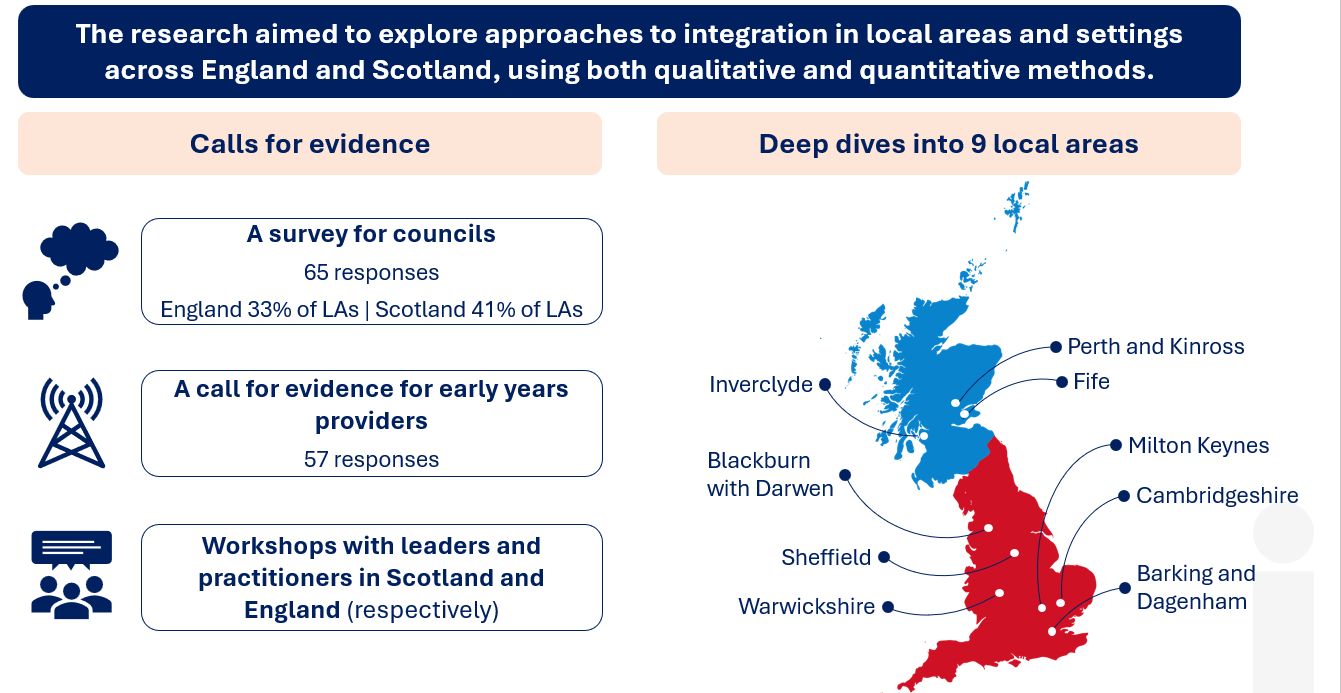
The research took between June 2025 and May 2026, and involved gathering a range of quantitative and qualitative evidence.
Headline findings
Early years settings are increasingly playing a broader role in supporting families – settings are in a unique position to build relationships and connect families to support. They are playing a more direct role in delivering support relating to home learning and parenting, and more of an indirect role connecting parents to support around family wellbeing and socio-economic hardship. This is not, however, a consistent picture across all settings and local areas – even among those that have stepped into this broader role, there are concerns about long-term sustainability.
The role of early years settings in supporting families does not exist in isolation, but instead forms part of an “ecosystem” of support for families. There are a range of ways in which early years settings and family services work together, which depend on how local services for families are organised, and how accessible and effective they are perceived to be. There is, however, no hard-and-fast rule about which models are likely to work best. Instead, the most effective approaches are those that are tailored to their local context and sufficiently flexible to adapt to families’ and communities’ needs.
There was a strong view that greater integration between early years education and support for families should be pursued within national policy – 98% of early years providers and 95% of local authorities that responded to our surveys agreed or strongly agreed that greater integration would improve outcomes for children and families.
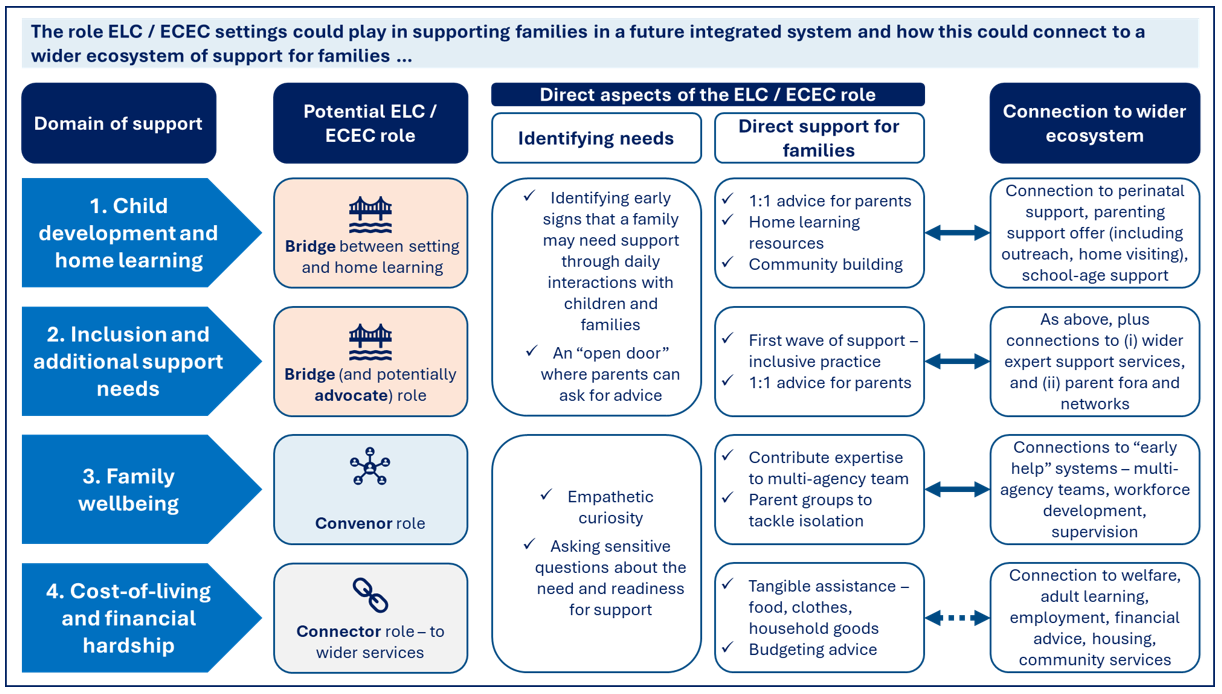
In our report, we made five recommendations for national policymakers and local system leaders in England and Scotland. The main recommendation was national policymakers should formally recognise, build on and define the role of early years settings in supporting families. The graphic below summarises the roles in supporting families we proposed for early years settings (and the respective roles within the wider ecosystem of family services). We proposed –
a more direct role for early years settings as a “bridge” in relation to child development and home learning, and inclusion and additional support;
a role as a “convenor” of a range of services that need to work together to support family and parent wellbeing; and
a role as a “connector” to wider services that can support families experiencing hardship.
We have been encouraged by the initial response to the research and our recommendations - for example, the “conceptual framework” we developed to explore integration was featured in the UK Government’s Best Start Family Hubs and Healthy Babies guidance for local authorities in England.
To read more about our findings and recommendations, read our full report here.