Local SEND system reform and the role of Experts at Hand
Experts at Hand: The opportunity
In the past few weeks, leaders of local SEND systems have been receiving the Government’s verdict on the local SEND reform plans they submitted in the summer. This marks the start of the first phase of the Government’s proposed transformation of support for children and young people with SEND and the creation of a more inclusive education system.
Central to this initial – local – phase of reform is the development of “Experts at Hand”. The principle behind Experts at Hand is one we have championed in our work over the past decade – namely, rebalancing the system so that support from education, health and family services are available earlier and as part of a core entitlement for schools and settings. In our 2024 report on a future SEND system, we wrote: ‘We propose the development of a new “core offer” of targeted, multi -disciplinary support – from therapists, EPs and other services – that all education settings can access without children and young people requiring a statutory plan.’
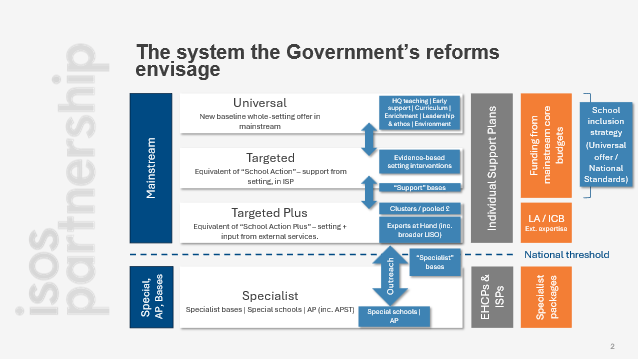
Experts at Hand represents a major opportunity to use the system’s considerable expertise earlier, in a more holistic way, and in a way that enhances the knowledge, skills and confidence of educators in schools and settings. Both Experts at Hand and SEN clusters (about which more below) are situated in what Government are calling the “Targeted Plus” tier of a future system. As our summary graphic below seeks to illustrate, this tier is crucial not only in its own right, but also in building the capacity of mainstream schools and settings and reducing the pressure on specialist provision.
We have been fortunate to work with a number of local areas – individually and through the What Works in SEND programme – as they develop their Experts at Hand offer. Despite the complexity of the task, many local areas welcome Experts at Hand and see its potential to improve support for young people, families and settings.
In this blog, we describe some of the key strategic questions and choices that have shaped how local areas are developing their approach to Experts at Hand –
how they are balancing competing pressures in Year 1;
how the design of their Experts at Hand offer is shaped by each local area’s starting point;
three key questions about local areas are grappling with when thinking about how to incorporate Experts at Hand into their local (SEND) systems; and
looking to Year 2 and beyond.
Balancing competing pressures in Year 1
Local areas are grappling with the challenge of managing a process of major system change while maintaining an existing system in need of reform and that is under ever-increasing pressure. Leaders in the local areas with whom we are working have described how they see one of the key challenges in Year 1 of the reform programme being about the need to balance –
the ambition to work with partners, schools and settings, parents and young people to co-develop a sustainable and effective approach to providing targeted plus support; and
getting a new offer set up and delivering so as to be in a position to demonstrate impact within the first year.
Leaders in local areas want to carve out sufficient time to co-develop an offer with partners that is going to make a significant difference in practice. They are cautious about rushing implementation and the risk of “throwing support at schools and settings” that is absorbed by the system without achieving any significant change.
Local areas have very different starting points for developing their Experts at Hand offer
While the national policy ambition behind Experts at Hand – and the guidance about what local areas are expected to do – is clear, there remains plenty of scope for local areas to consider how Experts at Hand best aligns with their existing systems of support. Below are three key considerations about how and from what starting point Experts at Hand should be developed.
What is in place already? – Experts at Hand is not intended to be a new “service” or referral route, but rather to provide additionality that enhances existing offers of targeted plus support. This means that local areas’ approaches to Experts at Hand will be different according to whether the local area already has a strong local inclusion support offer in place (where Experts at Hand may add extra capacity and breadth to be incorporated into an existing offer) or not (where Experts at Hand may represent an opportunity to develop a new offer of support at the targeted plus tier).
What will be the scope of Experts at Hand in Year 1? – most of the local areas with which we are working are focusing on developing the Experts at Hand offer for schools in the first instance, and then considering how the offer might be adapted for early years and post-16. Some local areas already have a strong multi-disciplinary support offer – a proto-Experts-at-Hand – in the early years, and are considering how they can extend that model to the school sector. While the inclusion of post-16 settings with Experts at Hand has been universally welcomed, local areas have acknowledged that the targeted plus support offer to post-16 settings has been less well-established in the past and needs to be put in place from scratch.
On what scale will Experts at Hand be developed in Year 1? – another key question that local areas are considering is whether to pilot Experts at Hand – either in specific localities or to test specific aspects of the offer – or to roll-out and test an initial offer for all settings across their local area. Partly, local areas’ choices have depended on their starting point: local areas that have an existing targeted plus offer in place are more likely to be in a position of piloting aspects of Experts at Hand (what is most effective in adding value to the existing offer), whereas local areas with a limited existing targeted plus offer are more likely to want to roll-out an initial new Experts at Hand offer to all settings to ensure full coverage and rapid uptake.
Experts at Hand within the wider local system
The considerations of starting point, scope and scale emphasise how much Experts at Hand cannot be seen in isolation, but instead need to be integrated into a coherent vision for each local SEND system. In addition to the overarching considerations above, we have found that there are three specific questions facing local areas regarding the design of their Experts at Hand offer.
Question 1: What is the current infrastructure through which schools / settings come together with one another and with wider services to discuss additional support?
Since Experts at Hand is not a new service, local areas need to consider how to incorporate the additional support Experts at Hand is intended to provide within the existing structures through which schools / settings and services discuss additional support. For some local areas, this requires creating a new infrastructure, but others have existing approaches into which Experts at Hand can be incorporated. (For some, there is also the need to future-proof those structures with an eye on local government reorganisation.)
It is here that there is potentially a vital link to be made between Experts at Hand and local SEND “clusters”. The idea of schools coming together to share expertise and resources is part of the Government’s reforms, but there are multiple examples of existing models of SEND clusters into which Experts at Hand can be – and is being – integrated. There are different models of SEND clusters, and these vary by size and role. Some focus on commissioning additional support (such as in South Gloucestershire). Other focus on collaborative decision-making and enhancing inclusive practice (such as in Kirklees).
We think that SEND clusters have the potential to provide the foundations – both the infrastructure and the culture – that could connect Experts at Hand to peer-to-peer collaboration and collective decision-making between schools / settings and wider services. Where they are implemented and maintained successfully, SEND clusters can –
foster a culture of collaboration, collective responsibility and shared custodianship of local resources between schools / settings and services;
enable a more joined-up approach to supporting children, young people and families within localities;
make a reality of there being “no wrong door” when requesting support;
improve practitioner skills and confidence;
shift discussions of additional support away from requests for individual pupils and towards cohort, whole-school and cross-school support that is more impactful and long-lasting; and
reduce the reliance on statutory assessments as the sole way to access additional support.
Question 2: Who are the “experts” that need to work together with schools / settings, where does capacity exist and how can local areas develop and bring that expertise together?
Many local areas are considering how to align Experts at Hand with a broader range of holistic support for children, young people and families. While Experts at Hand relates to four professional disciplines –
speech and language therapy (SALT);
occupational therapy (OT);
educational psychology (EP); and
specialist teachers –
evidence of what is needed in local areas has often led local area leaders to recognise that the support a child / young person may need cannot always be provided by sending in a single “expert”. Instead, local leaders have been increasingly thinking about how Experts at Hand can be aligned with Best Start Family Hubs, Family First Partnerships, mental health support teams and Neighbourhood health teams in order to enable more holistic support for families and education settings.
From a practical perspective, this also requires local areas to take a proactive approach to mapping existing provision in these areas, identifying gaps and workforce planning. Most of the local areas with which we are working are taking a phased approached to the development of their Experts at Hand offer. In the initial phase, they are focusing on aspects of Experts at Hand that can be expanded rapidly (specialist teachers, outreach and, in some cases, EP), with SALT and OT developing on a more gradual timeline. This has also served to highlight the important role played by “system connectors” – for example, the new SALT Advanced Practitioner role – that can work between sectors to map existing provision and identify opportunities to create and deploy expertise.
Question 3: How will external experts work with educators in schools / settings to offer support and build capacity?
Crucial to the success of Experts at Hand is the precise way in which the “experts” work with the “educators” to share knowledge, build confidence, and embed practices in mainstream settings. Local areas are considering a range of ways in which this might work in their local areas – many drawing on the experiences of PINS (Partnership for Inclusion and Neurodiversity in Schools) and ELSEC (Early Language Support for Every Child), for example.
The key considerations being explored by local areas are who is working with whom, when, and on what basis. Will Experts at Hand work through individual “experts” working with individual “educators” in schools and settings in response to individual referrals? Alternatively, will access to additional, expert support be through strategic conversations between a locality advisor / coordinator and a school’s / setting’s senior leadership to agree strategic priorities for whole-school inclusive practice? Some local areas are developing a multi-layered approach –
an initial strategic conversation with the senior leadership of each school / setting to agree priorities for support; and
a locality / cluster structure to access additional / exceptional support from local services; and
a dynamic approach to commissioning support based on local priorities.
What next?
As well as the immediate task of designing, refining and establishing the Year 1 Experts at Hand model, there are some broader, longer-term considerations that local areas are exploring.
The transition to Year 2 and beyond – while local areas are awaiting further Government guidance about Year 2, Government have been explicit that the investment in Experts at Hand will continue across a three-year period. While many local areas are focusing on designing their offer for particular phases of education, we think the multi-year nature of the initiative presents an invaluable opportunity to consider how additional expert support could help at key transition points between phases of education – particularly between early years and the start of school, primary and secondary, and into post-16.
Measuring effectiveness – local areas are considering how they will track the effectiveness of Experts at Hand, both to provide real-time feedback that can be used to fine-tune their approach and when reporting to central government. Local areas are planning to capture a range of evidence, including (a) reach of services, (b) outcomes for children and young people, (c) experiences of families and practitioners, and (d) impact on wider system indicators of inclusivity and demand for specialist services. Some are calibrating their evaluative approaches to the stages of maturity of their Experts at Hand offer, focusing on whether the model is working as intended and reach / access in the first phase, with a more granular focus on setting- and child-level impact in the next phase, and then a wider view of system-level impact as the approach becomes embedded.
Governance and sustainability – another key consideration for local areas is how to connect the existing formal partnership structures with structures used for engagement, communication and co-development of Experts at Hand in order to create formal governance around Experts at Hand (and more broadly the work to foster inclusive practice and targeted plus support) to ensure this is embedded, effective and sustainable in the long term.
As we said at the outset, Experts at Hand is central to many local areas’ local SEND reform plans, and to the initial stage of the Government’s reforms. If you are interested in hearing more about what we are learning around Experts at Hand, do drop us a line at info@isospartnership.com.