
"Rising needs in the early years?" - Trends, implications and solutions
(This article is a summary of our research for the Local Government Association on rising needs in the early years, and was written by Ben Bryant and Jodie Reed for publication in Nursery World. Our full research report can be read here.)
Introduction
During our work over the past few years, we encountered a strange phenomenon. Doing research in education and children’s services, we get to speak to leaders of all phases and types of education settings, local authorities, and health services, as well as hearing directly from families. Whatever project we have been working on, sooner or later someone talks about “rising needs in the early years”.
There is evidence that this is the case. In the most recent DfE survey of early years providers, 95% reported a rise in the number of children with identified special educational needs and disability (SEND). The growth in education, health and care plans (EHCPs) issued has been greatest for children under 5 – a near 70% increase over five years, compared to an average of 57% for all age-groups. The most common ages for EHCPs to be issued are now 4 and 5. The gap in outcomes for children who are disadvantaged or have SEND grows ever wider.
What, though, lies behind these trends, what is causing them, and what, crucially, should be done? Last spring, we were asked by the Local Government Association (LGA) to get “under the bonnet” and capture what early years practitioners are seeing, as well as how parents are experiencing the current system. Drawing on surveys and extensive interviews with early years providers, wider practitioners working with young children and families, and parents and carers, our research, published last autumn, attempted to set out a more precise understanding of –
what practitioners think is changing when they describe “rising needs” and “greater complexity” and what might be driving this;
how well the current early education and childcare system is responding to those trends; and
what national policy changes might make a difference.
Are needs rising in the early years?
In short, yes. Our research showed the practitioners see providing a broader range of more intensive support to a larger number of children.
In our survey, 90% of early years practitioners, and 100% of their LA counterparts, said either that the volume of children requiring additional support, or complexity and intensity of support are rising, or both – the latter was the most common answer, given by 61% of early years practitioners and 95% of LA practitioners. Many of the individual providers and local services showed, from their own figures, growing numbers of children requiring additional support.
What, then, did early years practitioners say was changing? Those we heard from consistently highlighted the increase in support for required around children’s communication and interaction. They argued that over the past 10-15 years there had been a shift in the nature and complexity of children’s communication and interaction needs – and associated social, emotional and mental health needs, with more children requiring more intensive support in four broad areas –
cases where children have very little or no language, or where the mix of communication and language needs mean children cannot communicate their wants and feelings;
support for children around their social interactions with peers and adults, and needing greater support around playing, sharing and taking turns;
support for children to interact and engage with activities beyond their immediate interests; and
support for children’s sensory (seeking and averting) needs.
What did practitioners think was driving these changes?
Our research suggests that there is a multi-faceted set of inter-related factors driving these trends, including changes in underlying needs, as well as experiences that can exacerbate needs and factors that can make the different ways children develop more visible.
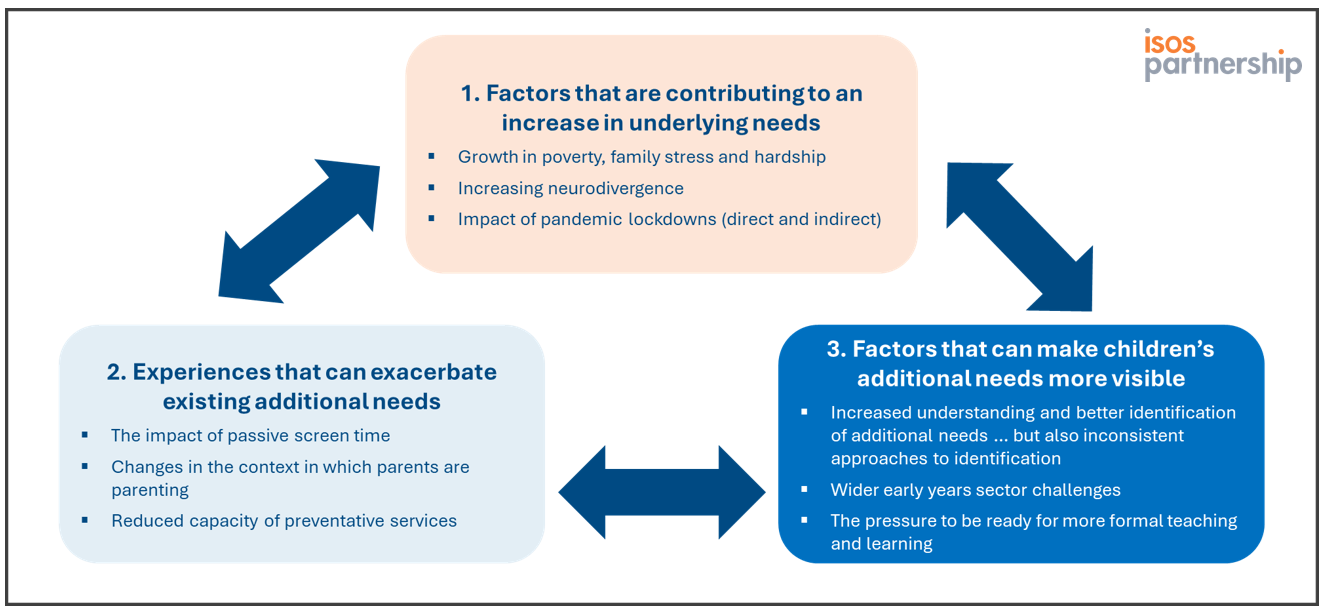
Practitioners consistently highlighted the pressure to provide additional support to combat the effects of growing poverty. Parental wellbeing and stress, as a result of hardship, was seen as reducing the quality time and energy parents could spend with their children, with implications for professionals.
Practitioners also described an increase in neurodivergence, including children presenting with autistic traits. One therapist described this as ‘an organic and fundamental change’, the roots of which are not obvious. Recognising that the presentation could be similar in very young children, practitioners argued that they were seeing an increase in both autistic children and those who had needs relating to attachment and trauma.
In addition, practitioners considered that the coronavirus pandemic – the reduced capacity of family services, less in-person contact, family isolation from wider networks and loss of opportunities for children to play – was continuing to have a lasting impact, including for children born after the lockdowns.
A big theme in our research – and one that came up in every conversation – was the impact of passive screen time. While acknowledged as a useful feature of daily life for families and practitioners, there was growing concern (substantiated in wider research evidence) about the potentially negative effects of passive screen use by children and adults on children’s development and their acquisition of language.
Overall, our research suggested that “rising needs in the early years” does not solely reflect a rise in SEND, but instead that the rise in the identification of SEND in the early years is itself a reflection of a much broader and more complex set of trends leading to more children requiring additional support in their early years.
How is the current system responding to these changes?
The good news is that many early years practitioners report taking a pro-active approach to adapt their practices – 76% reported doing more work with external services, 70% reported investing more in staff training, and over half reported making changes to the structure of their days and/or the curriculum.
We also heard numerous examples of early years providers helping families navigate the current system, as well as contributing to new area-wide initiatives. A key finding from our research was that where families have a positive experience of getting additional support for their child, early years providers are central to this. In many instances, early years practitioners, building on their understanding of a child and their relationships with a family, are the “lynchpin” connecting families to the support that they need.
Parents described the importance of finding a setting, and often a key person within that setting, who listened, understood and “got” their child. As one parent put it, their nursery ‘had a really good SEND lead … I got to know those people very well. They really understood … Without them we wouldn’t have got any support.’ As more children access early years education provision, and from an earlier age, there is enormous potential to build on the role that many early years providers are already playing.
While some early years providers go above and beyond to support their families, the trends we described earlier are creating significant challenges across the sector. Two thirds of providers told us that they are having to spend additional time seeking SEN inclusion funding or applying for an education, health and care needs assessment (EHCNA). A minority (38%) reported reducing hours for children who needed additional support, or having to turn children away due to not being able to meet their needs (24%). As a result, families’ experiences of accessing additional support for their children are not uniformly positive.
In our report, we identified three main challenges in how the current system is set up to respond to “rising needs in the early years”.
The “consistency of identification” challenge. While some early years providers act as a “lynchpin” for families, this role is not built into service expectations or resourced consistently. Parents describe frustrations when their concerns are not listened to or acted upon, and where delays can mean their children miss out on timely support.
The “access” challenge. If early years providers are playing an increasingly important role in identifying and putting in place additional support, it is vital that all children have access to high-quality early years provision. Parents of children who needed additional support often report challenges in getting a place in an early years setting or accessing their full entitlement of funded hours. Research by Dingley’s Promise echoes this, finding that 41% of children with SEND were not accessing their full entitlement.
The “capacity” challenge. While the need to provide additional support is rising, resources and capacity of early years settings and other key services, such as health visiting or speech and language therapy, are under increasing strain. Spend on SEN inclusion funding has more than trebled over the past seven years – but it often does not feel enough, either in settings or to support children’s transition to school.
What are the solutions?
The recent IFS evaluation of Sure Start has shown that effective support in the early childhood can make a dramatic difference to children’s support needs later down the line. There is an opportunity now for national reforms to create a system that would more consistently support early years providers and wider services to respond positively and proactively to “rising needs in the early years”.
Achieving this will require five significant shifts.
Enhanced information for parents and professionals about child development, that recognises the different ways in which children develop, leading to a more positive, strengths-based approach that enables better early identification where children may need additional support.
Building capacity for inclusion across the early years sector, including workforce development and greater focus on ensuring full equity of access to early education for children who may need additional support.
Stronger expectations on joint-working amongst local education, health and care services to provide a more integrated additional support that wraps around early years settings.
Recognition of the importance of transitions in the early years matched by clearer expectations of transition support, resources, and continuity of pedagogy and curriculum.
A shift to using resources in a way that enables a more proactive approach to identification and continuity in provision of additional support.
While the recent white paper gives (rightly) significant attention to supporting inclusion in schools, we cannot fix the so-called “SEND crisis” and create a truly inclusive education system without developing a more holistic response to “rising needs in the early years.”